
Real Estate Marketing Funnel: From Ad Click to Site Visit & Booking
Most real estate campaigns do not fail at the ad. They fail in the gap between the ad click and the site visit.
A developer can generate hundreds of leads a week on Meta and Google, yet the sales team still complains about “junk leads” and empty sample flats. The problem is rarely the traffic. It is the absence of a structured real estate marketing funnel that moves a buyer from curiosity to a signed booking form.
In this guide, we break down the complete funnel used for residential, commercial and plotted real estate projects. You will see what happens at every stage, which metrics matter and where marketing budgets often leak.
What Is a Real Estate Marketing Funnel?
A real estate marketing funnel is the step-by-step journey a prospective buyer takes from first seeing your project to booking a unit. Each stage filters out unqualified prospects and moves serious buyers closer to a decision.
You may also hear it called a property sales funnel, real estate lead funnel or real estate conversion funnel.
A lead funnel focuses on capturing enquiries, a conversion funnel focuses on turning enquiries into visits and bookings, and a property sales funnel covers the complete journey. A strong strategy treats all three as one connected system.
Property is a high-ticket, emotional and slow decision. Buyers compare locations, developers, payment plans and possession timelines, often over weeks or months. That is why a structured funnel is essential in real estate.
The 6 Stages of a Real Estate Marketing Funnel
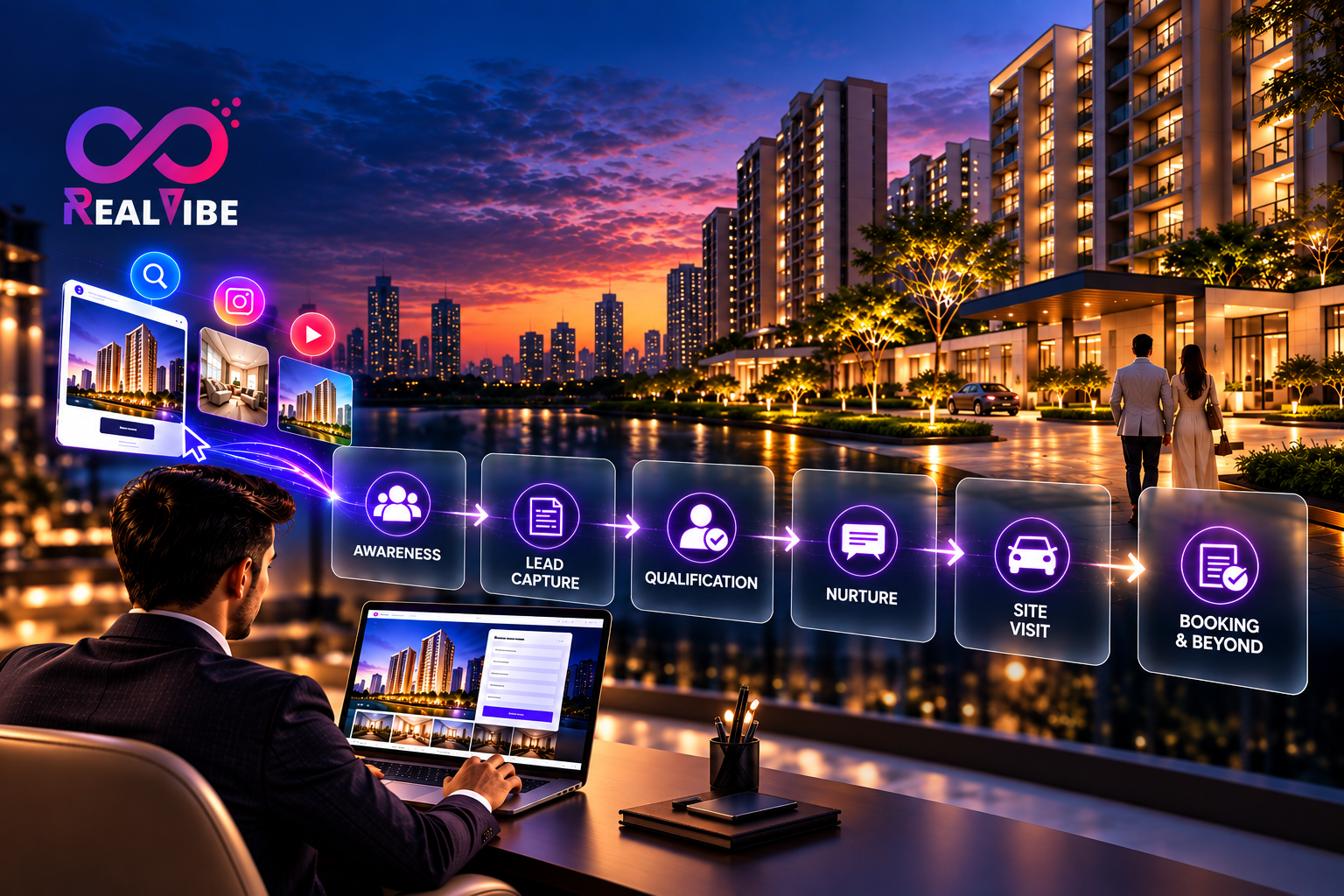
A complete real estate marketing funnel usually moves buyers through six key stages:
- Awareness: Reach and attract relevant property buyers.
- Lead Capture: Convert interest into measurable enquiries.
- Qualification: Identify buyers with genuine potential.
- Nurture: Stay present throughout the consideration period.
- Site Visit: Move qualified prospects into physical or virtual visits.
- Booking & Beyond: Convert visits into bookings, referrals and future audiences.
Stage 1: Awareness — Winning the Right Click
The top of the funnel determines the quality of everything below it. If your advertisements attract the wrong audience, no amount of calling or follow-up will completely fix the problem.
Lead With the Buyer’s Reason, Not the Brochure
Buyers are more likely to respond to a clear proposition such as a location advantage, starting price, possession date, configuration or payment plan than a generic line such as “luxury living redefined.”
Match the Platform to the Intent
- Google Search: Captures buyers who are already searching for properties, for example “3 BHK in Sector 63A Gurugram”. These users generally demonstrate stronger active intent.
- Meta — Facebook and Instagram: Helps create demand through visual storytelling, walkthrough reels, lifestyle creatives and UGC-style video formats.
- YouTube and Programmatic: Can support launches, reach, repeated exposure and brand recall for large projects.
Build Demand Before Capturing It
Not every potential buyer is actively searching for a property today. Demand generation helps introduce the project to relevant audiences before they develop strong search intent.
Use Meta, YouTube, Reels, video advertising and display campaigns to communicate:
- Project lifestyle
- Location advantages
- Configurations
- Amenities
- Developer credibility
- Connectivity
- Payment plans
- Key project USPs
Once prospects engage with the project, retarget them with stronger consideration and conversion communication.
Awareness → Interest → Consideration → Enquiry → Site Visit
Target by Geography and Life Stage
For most real estate projects, buyers come from a defined catchment around the site along with selected feeder cities or markets.
Create separate geographic tiers and consider using different budgets, messaging and creatives for primary and secondary markets.
Pre-Qualify Inside the Ad
Mentioning the starting price, configuration and location in the creative helps buyers understand whether the project fits their requirements before submitting a lead.
Stage 2: Lead Capture — Building a Real Estate Lead Funnel That Filters
The lead-capture stage is where your real estate lead funnel either protects your sales team or floods it with low-quality enquiries.
The objective should not simply be the cheapest possible lead. The more useful objective is generating qualified opportunities efficiently.
Instant Forms vs Landing Pages
Meta instant forms reduce friction and can generate substantial lead volume because users can submit their information without leaving the platform.
A dedicated landing page adds more friction, but it also gives buyers an opportunity to understand the project before submitting an enquiry.
Many projects benefit from testing both formats and comparing performance using cost per qualified lead rather than raw CPL alone.
Build Landing Pages for Decisions
- Headline with location, configuration and starting price
- Project highlights and amenities
- Connectivity information
- RERA information
- Possession or project timeline
- Floor plans
- Price-sheet enquiry options
- Short enquiry form above the fold
- WhatsApp and click-to-call options
- Developer track record and trust signals
Track Every Lead Source
Use UTM parameters and connect website and advertising forms with the CRM. This helps identify which campaign, audience and creative produced qualified leads, site visits and bookings.
Stage 3: Qualification — Speed Is Your Biggest Advantage
A property enquiry can cool down quickly. Buyers may enquire about several competing developments during the same research session.
Call Within Minutes, Not Hours
Set a clear first-response target for new enquiries. During working hours, teams can aim to respond within approximately 5 to 15 minutes.
Instant WhatsApp acknowledgement messages can also confirm receipt of the enquiry and share basic project information while the call is being routed.
Use a Simple Qualification Framework
- Budget: Does the buyer’s budget match available inventory?
- Requirement: Which configuration and size are they considering?
- Timeline: Are they ready now, planning in a few months or just exploring?
- Decision Maker: Who else is involved in the purchase decision?
Tag Every Lead in the CRM
CRM dispositions such as Hot, Warm, Cold, Not Reachable and Not Interested help marketing and sales teams maintain a shared understanding of lead quality.
Stage 4: Nurture — Staying Present Through a Long Decision
Most qualified buyers will not book a property during the first conversation. Nurturing keeps the project visible while buyers compare options, arrange finance and consult family.
WhatsApp as a Primary Follow-Up Channel
WhatsApp can support real estate lead nurturing through construction updates, price revisions, site-visit invitations, inventory updates and reminders.
Use Retargeting Ads
Retarget people who visited the landing page, watched project videos or submitted an enquiry.
- Project walkthroughs
- Sample-flat videos
- Testimonials
- Construction updates
- Location videos
- Payment-plan communication
- Relevant limited-period offers
Email for Depth
Use email for detailed information such as price sheets, payment-plan breakdowns, brochures, location reports and investment comparisons.
AI Calling for Faster Follow-Ups
AI-powered calling can support lead-management teams by contacting new and existing enquiries, handling basic qualification questions and identifying prospects that require human sales follow-up.
- Acknowledge new enquiries quickly
- Confirm buyer requirements
- Identify budget and configuration preferences
- Reconnect with older enquiries
- Confirm site-visit interest
- Route higher-intent responses to the sales team
Bulk Messaging for Continuous Engagement
Use compliant WhatsApp and SMS communication to reconnect with opted-in leads at scale.
- New inventory
- Price revisions
- Construction milestones
- Project events
- Site-visit opportunities
- Payment-plan announcements
- Possession updates
Segment prospects based on project interest, budget, location, configuration and funnel stage rather than sending the same communication to everyone.
Give the Buyer a Reason to Act
Launch pricing, changing inventory, festive offers or site-visit benefits can create genuine urgency when they reflect actual project conditions.
Stage 5: Site Visit — The Turning Point of the Real Estate Conversion Funnel
In the real estate conversion funnel, the site visit is one of the most important stages because buyers move from digital research to experiencing the project and surrounding location.
Make Scheduling Effortless
Instead of asking “When would you like to visit?”, offer clear choices such as:
“Would Saturday at 11 AM or Sunday at 4 PM work better for you?”
Reduce Site-Visit No-Shows
- Send immediate WhatsApp confirmation
- Share the location pin
- Send a reminder one day before
- Send another reminder shortly before the appointment
- Provide transport support where appropriate
Prepare the Sales Team
The relationship manager should already know the prospect’s budget, configuration, buying timeline and key concerns before the visit begins.
Use Virtual Site Visits for Distant Buyers
NRIs and outstation prospects can be supported through live video walkthroughs or virtual presentations before arranging an in-person visit.
Stage 6: Booking and Beyond — Closing the Property Sales Funnel
The final stage converts an interested visitor into a buyer and creates opportunities for referrals and future campaign audiences.
Follow Up After the Site Visit
Send a personalised follow-up with the specific inventory, cost sheet and payment plan discussed during the visit.
Remove Friction From Booking
- Booking amount
- Documentation requirements
- Payment schedule
- Loan-assistance process
- Terms and conditions
- Available inventory details
Turn Buyers Into a Referral Engine
Referral programmes, construction-update communities, customer events and possession experiences can support word-of-mouth and testimonials.
Feed Booking Data Back Into Advertising
Where privacy requirements and platform policies permit, use qualified-lead, site-visit and booking data to improve advertising optimisation and audience signals.
Real Estate Marketing Funnel Metrics That Actually Matter
Tracking the right metrics at every funnel stage helps marketing and sales teams understand where prospects are engaging, dropping off or converting.
| Funnel Stage | Key Metrics | What It Tells You |
|---|---|---|
| Awareness | CTR, CPM, Video View Rate | Is the creative relevant to the target audience? |
| Lead Capture | Cost per Lead, Landing Page Conversion Rate | Is the offer and landing page convincing? |
| Qualification | Connect Rate, Qualified Lead % | Are lead quality and follow-up processes working? |
| Nurture | WhatsApp Response Rate, Retargeting CTR | Are potential buyers continuing to engage? |
| Site Visit | Lead-to-Visit %, Cost per Site Visit | Is the funnel generating actual project visits? |
| Booking | Visit-to-Booking %, Cost per Booking | Is the complete funnel producing sustainable business outcomes? |
Optimise for Site Visits and Bookings, Not Just Leads
A lower CPL does not automatically mean a stronger campaign. Marketing teams should also monitor:
- Cost per qualified lead
- Lead-to-connect rate
- Lead-to-site-visit rate
- Cost per site visit
- Visit-to-booking rate
- Cost per booking
- Customer acquisition cost
- Marketing ROI
Build a Connected Real Estate Marketing Funnel With RealVibe
A successful property campaign is not simply a Meta campaign, Google Ads account or landing page operating independently.
The strongest real estate marketing systems connect demand generation, lead capture, qualification, CRM data, nurturing, site visits and booking outcomes into one measurable journey.
RealVibe Digital Media plans and manages end-to-end real estate marketing campaigns for developers across Delhi NCR and other markets.
Our work spans performance marketing, creative strategy, landing pages, digital media planning, lead-quality reporting and CRM-connected marketing.
If your campaigns are generating enquiries but not enough qualified site visits, the problem may be somewhere inside the funnel rather than at the advertisement itself.
Frequently Asked Questions
1. Why is a real estate marketing funnel important for property sales?
A real estate marketing funnel creates a structured journey from awareness to enquiry, qualification, site visit and booking. It helps marketing and sales teams understand where prospects drop off and where improvements are needed.
2. How can developers generate more qualified real estate leads?
Use precise targeting, communicate the project configuration and starting price clearly, create dedicated landing pages and include qualification questions in lead forms.
3. What is demand generation in real estate marketing?
Demand generation creates awareness and interest before buyers actively start searching. Meta Ads, YouTube, walkthroughs and educational content can build consideration, while Search captures stronger active intent.
4. How can AI improve real estate lead nurturing?
AI can support automated calling, lead prioritisation, personalised communication and CRM workflows, helping sales teams identify prospects who require faster human follow-up.
5. What content should be used to nurture property buyers?
Use project walkthroughs, construction updates, location advantages, floor plans, payment plans, testimonials, inventory updates and site-visit invitations.
6. How can developers convert more real estate leads into site visits?
Improve qualification, respond quickly, offer specific appointment slots, use personalised WhatsApp follow-ups and send timely visit reminders.
7. Which metrics should be tracked in a real estate sales funnel?
Track qualified leads, cost per qualified lead, lead-to-connect rate, lead-to-site-visit rate, cost per site visit, visit-to-booking rate, cost per booking, customer acquisition cost and marketing ROI.