
RERA Compliance in Real Estate Marketing: What Developers Can and Cannot Advertise
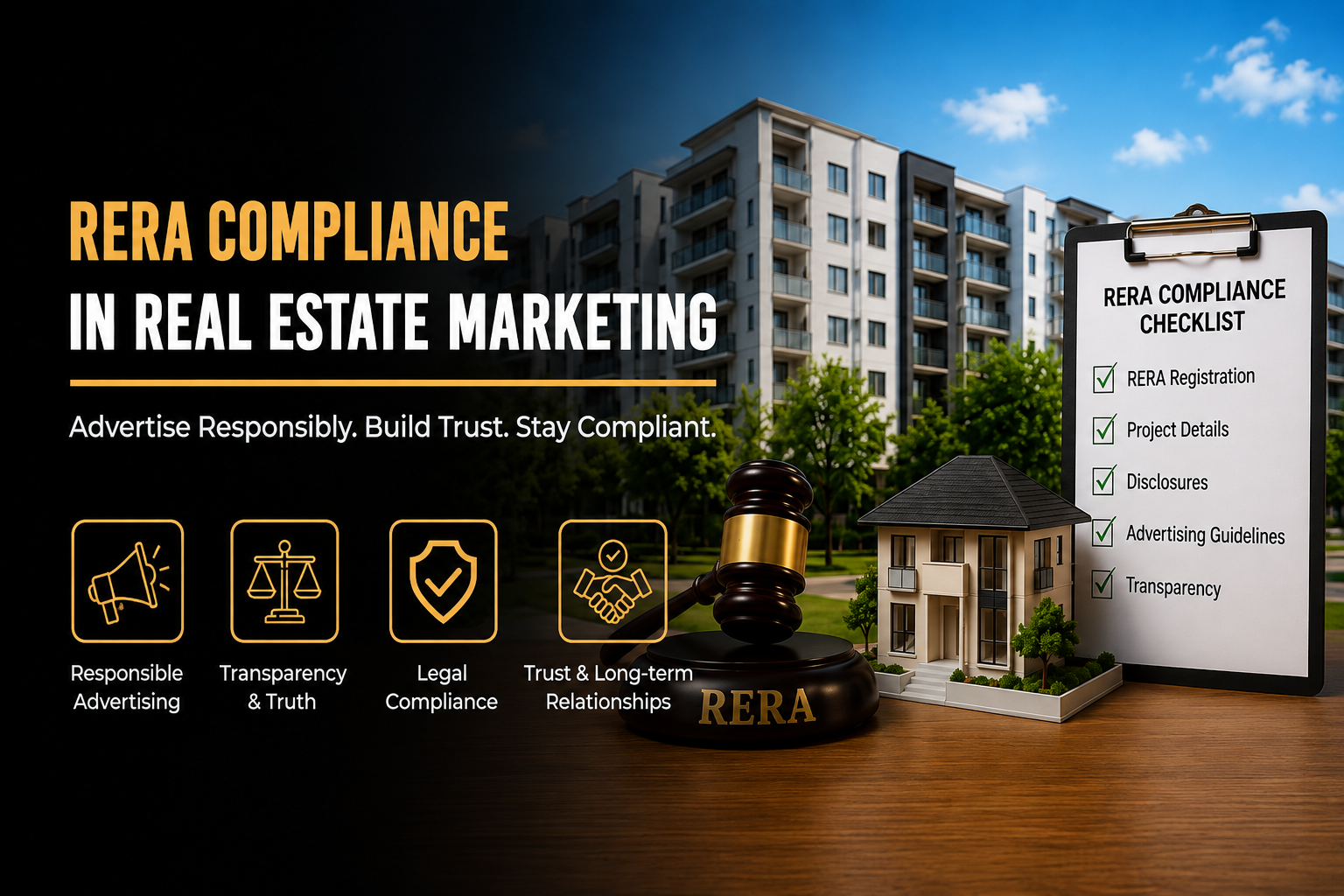
There is a particular kind of meeting that happens two days before a launch. The creative is approved, the media plan is loaded, the hoardings are printed — and someone finally asks whether the project registration has actually come through.
Under the Real Estate (Regulation and Development) Act, 2016, that question has only one acceptable answer, and asking it two days before launch is roughly eight weeks too late.
RERA compliance is usually treated as a legal function that reviews marketing at the end. It works far better as a constraint written into the creative brief at the start. This piece covers what the Act actually prohibits, what the Haryana authority specifically requires in Gurugram, where marketing teams get caught, and how to build a workflow that doesn't slow a launch down.
1. You Cannot Advertise Before Registration. There Is No Pre-Launch Exemption.
Under the Real Estate (Regulation and Development) Act, 2016, Section 3 is unambiguous: no promoter shall advertise, market, book, sell or offer for sale — or invite persons to purchase in any manner — any plot, apartment or building in a real estate project, without first registering the project with the Authority.
Read that list again. Advertise and market sit alongside sell. The prohibition is not on taking money. It is on the marketing itself.
This is where the industry's most persistent habit runs into the Act. "Pre-launch", "soft launch", "expression of interest", "priority registration", "founder member pricing" — these are marketing activities for an unregistered project. Authorities have consistently treated them that way; MahaRERA, in the widely cited Ashok Developers matter, held that an expression-of-interest campaign amounted to marketing under Section 3.
Practically, this means your launch calendar has one immovable dependency. Registration comes first, and creative production, media booking and channel-partner briefing all schedule backwards from the registration certificate — not from the sales team's preferred launch date.
2. "Advertisement" Means Far More Than You Think
Most compliance failures aren't newspaper ads. They're the things nobody classified as advertising.
Under the RERA act, 2016 Section 2(b) defines an advertisement as any document described or issued as an advertisement through any medium, and includes any notice, circular, other document, or publicity in any form, that informs people about a real estate project, offers a plot or apartment for sale, or invites people to purchase or to make advances or deposits.
The Haryana authority spelled out the consequence in its 2021 directions to promoters: the definition is extensive and almost every kind of promotional activity falls inside it, expressly including social media, SMS and email. HARERA went further and noted that a model apartment or sample flat is itself an advertisement, because it is publicity presented to the public to inform them about the project.
So the following are all advertisements, and all carry the same obligations as a full-page print ad:
- Instagram and Facebook creatives, carousels, reels and Stories
- Google Search text ads and display banners
- Project landing pages and microsites
- WhatsApp broadcasts and bulk SMS
- Email campaigns to a purchased or owned database
- Brochures, leaflets, pamphlets and cost sheets
- Hoardings, unipoles, site signage
- Radio spots, TV commercials, video walkthroughs, YouTube pre-rolls
- Influencer and channel-partner content promoting the project
- The sample flat itself
If a marketing team is checking compliance on print and hoardings only, most of the exposure is sitting untouched in the digital plan.
3. Every Advertisement Must Carry the Registration Number and the Authority's Website
Section 11(2) of the RERA Act, 2016 requires that any advertisement or prospectus issued by a promoter must prominently mention the Authority's website address, where the registered project's details are entered, and must include the registration number obtained from the Authority.
Two words in that clause do the heavy lifting: prominently, and include. A registration number in 6pt grey text at the bottom of a hoarding technically includes it. It does not prominently mention it — and HARERA Gurugram has explicitly listed poor font size and light font colour as a frequently observed contravention.

What HARERA Gurugram specifically requires
The Gurugram authority issued binding directions in February 2021 (No. 3/RERA GGM Directions 2021) prescribing exactly how compliance is to be executed across media:
Placement and legibility. The RERA registration number and the Authority's website address must be written in bold letters, on the top right of the advertisement.
Print and digital news. Newspaper ads, e-paper formats and website advertisements must carry the HARERA Gurugram website address (haryanarera.gov.in) and the registration number exactly as issued in the registration certificate — in the full format, e.g. RC/REP/HARERA/GGM/415/147/2020/31.
Brochures and leaflets. Same requirement as print.
Outdoor. Billboards and hoardings must carry both, sized so they are easily readable with the naked eye by the viewer.
Audio and audio-visual. Radio, TV, video clips, streaming and digital media content must state an abridged registration number in a clearly audible manner, along with the Authority's website address. A registration number that appears only as an end-card super on a 30-second reel does not satisfy an audibility requirement.
Brochure filing. A copy of any prospectus, brochure or pamphlet used to convey project information to prospective buyers is to be submitted to the Authority at least seven days before it is printed or circulated.
4. The Claim Itself Has to Be True
The RERA Act of Section 12 places the obligation to ensure the veracity of the advertisement or prospectus squarely on the promoter. Where a person makes an advance or deposit based on information in a notice, advertisement, prospectus, or on the basis of a model apartment, and suffers loss because of any incorrect or false statement in it, the promoter must compensate them. If the buyer chooses to withdraw from the project on that basis, the entire investment must be returned with interest, plus compensation.
That converts a copywriting decision into a refund liability. Some concrete implications:
Amenities. Show only what is in the approved plan. Haryana RERA, in Ramesh Chander Sharma, held that promotional material depicting facilities not included in the sanctioned plan constituted a misleading advertisement and directed withdrawal of the material. The clubhouse render that "reflects design intent" is a Section 12 problem if the sanctioned plan doesn't include it.
Possession dates. Whatever date appears in your ad should match the date declared to the Authority. Marketing an earlier date than the registered one creates a documented gap between what you told the regulator and what you told the buyer.
Area. Carpet area is the Act's disclosure basis. Advertising super area alone, without carpet area, is the single most common legacy habit still visible in NCR creative.
Returns. Assured return, guaranteed rental, guaranteed appreciation and buyback promises are not marketing claims — they are financial commitments that attract scrutiny under RERA and, separately, under deposit regulation. Avoid the entire vocabulary.
Disclaimers that disclaim the Act. HARERA specifically flagged advertisements claiming that purchase decisions made on the basis of the advertisement carry no consequences under the RERA Act. You cannot contract out of the statute in a footnote.
5. Penalties, and Who Carries Them
Under the RERA Act 2016:
- Section 59 — advertising or marketing a project without registration attracts a penalty of up to 10% of the estimated project cost. Continued violation can attract imprisonment of up to three years, or a further fine, or both.
- Section 61 — contravention of other provisions, including the Section 11(2) advertising disclosure requirement, attracts a penalty of up to 5% of the estimated project cost. UP-RERA has publicly confirmed this exposure while issuing notices for Section 11 advertising violations.
- Section 63 — failure to comply with an order of the Authority attracts a daily penalty which may cumulatively extend to 5% of the estimated project cost.
On a project of any meaningful size, a percentage of project cost is not a compliance line item. It is a P&L event.
And there is one point developers should read twice. HARERA Gurugram stated it directly: for advertising violations the promoter is solely liable, and the onus will not be allowed to be shifted onto the advertising agency, which is treated as a mere executor of work assigned to it.
Your agency's compliance discipline is therefore not the agency's risk. It is yours. Which is a reasonable argument for choosing an agency that treats it as a production step rather than an afterthought.
6. Channel Partners and Agents Are In Scope Too
Real estate agents must be registered under the RER Act of Section 9 and are separately obliged under Section 10 not to facilitate the sale of an unregistered project or to be party to misleading advertisements.
This matters because a large share of NCR project marketing is executed by channel partners running their own Meta accounts, their own landing pages and their own WhatsApp broadcasts. A developer who runs immaculate in-house compliance can still find non-compliant creative circulating under their project name.
The workable fix is unglamorous: supply channel partners with an approved, compliance-checked creative kit and approved landing page templates, and make continued lead allocation conditional on using them. Partners generally comply when the alternative is losing lead flow.
7. The Platform Layer Sits on Top
Meta and Google enforce their own housing and financial-services policies independently of any regulator. They reject real estate creative for reasons that have nothing to do with RERA — restricted targeting categories on housing ads, prohibited financial claims, landing page policy mismatches.
The practical result: a non-compliant asset usually fails at ad review before an authority ever sees it, which produces launch-week delays that get blamed on "the platform being difficult". Building compliance into the asset upfront removes both problems at once. It also removes the rework cycle that quietly costs a launch its first ten days of media momentum.
8. A Marketing Team's Working Checklist
Before any asset goes live:
- Is the project registered, and is the registration certificate on file?
- Is the registration number reproduced exactly as issued — full format for print, abridged only where the Authority permits it?
- Is the number and the Authority website in bold, top right, legible at actual viewing distance?
- For video and audio: is the number audible, not only visible?
- Does every amenity shown exist in the sanctioned plan?
- Does the possession date match the registered declaration?
- Is the carpet area disclosed?
- Are there any assured-return, guaranteed-appreciation or buyback claims? Remove them.
- Has the brochure been filed with the Authority at least seven days before circulation?
- Do channel partner creatives carry the same compliance, and are they using approved templates?
- Is the landing page compliant, not just the ad?
- Is there a dated archive of every published creative, in case a claim is questioned later?
That twelfth point is worth the trouble. Disputes surface eighteen months after a campaign ends, and the ability to show exactly what was published, when, resolves most of them quickly.

Compliance and Performance Are Not in Tension
The common assumption is that RERA constraints blunt marketing effectiveness. In practice the opposite holds. Copy built on verifiable specifics — actual carpet area, actual possession date, actual approved amenities, actual connectivity — converts better with a buyer spending several crores than superlatives do, because that buyer is already cross-checking everything on the authority's portal before they call you.
Compliance also protects the funnel directly. Non-compliant creative gets rejected mid-flight, which is the most expensive form of downtime during a launch window. We've written separately about the mechanics of getting that funnel right in our guide to real estate lead generation, and about the broader system in our overview of what a real estate digital marketing agency in Gurgaon/NCR does.
At RealVibe, every asset is compliance-checked before it reaches an ad account — not after a rejection. If you'd like your current creative and landing pages reviewed against this checklist, get in touch.
Frequently Asked Questions
Q1. What is RERA compliance in real estate marketing?
It is the set of obligations under the Real Estate (Regulation and Development) Act, 2016 governing how a project may be advertised — chiefly that no project may be marketed before registration, that every advertisement must prominently display the RERA registration number and the authority's website, and that all claims made must be truthful and verifiable.
Q2. Can a real estate project be advertised before RERA registration?
No, Section 3 prohibits advertising, marketing, booking, selling or offering for sale any project before registration. There is no pre-launch or soft-launch exemption, and expression-of-interest campaigns have been treated as marketing by authorities.
Q3. Do social media posts count as advertisements under RERA?
Yes. The definition in Section 2(b) under the RERA Act covers publicity in any form through any medium, and HARERA Gurugram has expressly noted that it extends to social media, SMS and email. Instagram creatives, WhatsApp broadcasts and influencer content all carry the same obligations as a newspaper ad.
Q4. Where must the RERA registration number appear on an advertisement?
Under the RERA Act Section 11(2) requires it prominently, along with the authority's website address. HARERA Gurugram directs that both appear in bold letters on the top right of the advertisement, legible to the naked eye, with an audible mention in audio and audio-visual media.
Q5. What is the penalty for advertising a project without RERA registration?
Up to 10% of the estimated project cost under Section 59, with continued violation attracting imprisonment of up to three years, or further fine, or both.
Q6. What is the penalty for missing the RERA registration number in an ad?
Contravention of Section 11(2) falls under Section 61, which provides for a penalty of up to 5% of the estimated project cost.
Q7. Is the advertising agency liable for a non-compliant real estate ad?
No, HARERA Gurugram has directed that the promoter is solely liable and that the onus cannot be shifted to the advertising agency, which is regarded as executing work assigned by the promoter. The developer carries the exposure.
Q8. Can a real estate ad promise assured returns or guaranteed appreciation?
No. Assured-return, guaranteed-appreciation and buyback claims are treated as misleading and attract action under RERA, and separately raise questions under deposit regulation. They should be removed from all creativity.
Q9. Does a brochure need to be submitted to the authority before circulation?
In Gurugram, yes. HARERA directs that a copy of the prospectus, brochure or pamphlet be submitted to the Authority at least seven days before printing or circulation.
Q10. Are RERA advertising rules the same across every state?
The central Act applies everywhere, but each authority issues its own directions on execution. Haryana operates authorities at Gurugram and Panchkula, and UP-RERA governs Noida and Greater Noida — so a campaign running across NCR complies with more than one set of formatting requirements.